New Opportunities
Period covered : 1826 to 1861
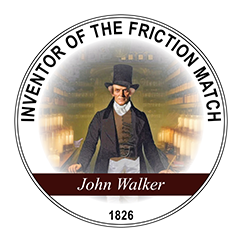
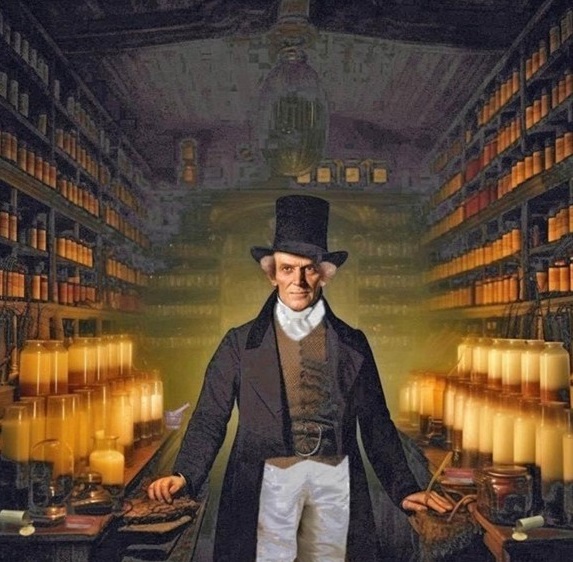
In his lifetime Walker never patented his invention, even though he was encouraged to do so. Instead, other people capitalised on it and created a huge, global industry bringing unimaginable wealth to just a few people.
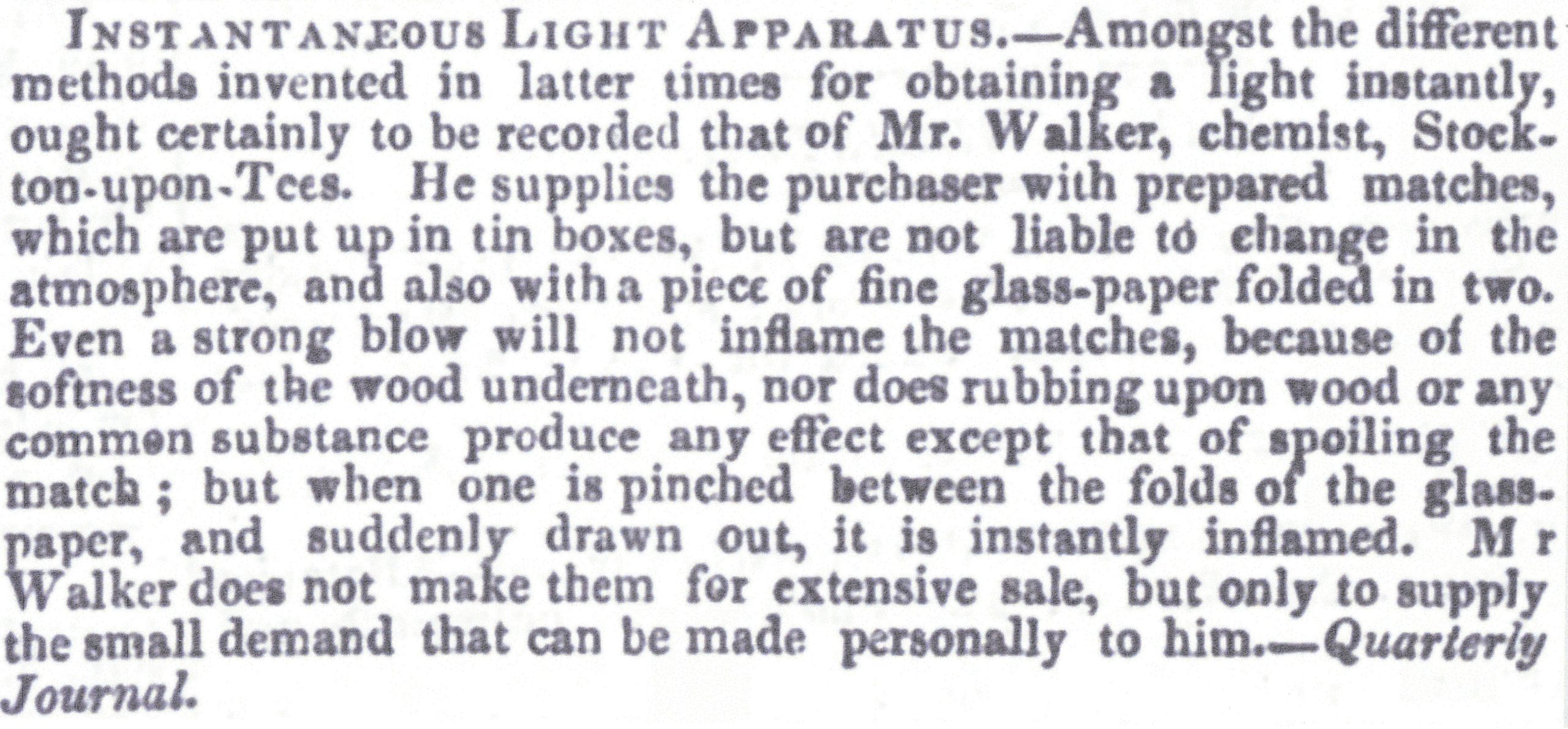
The first ever public mention was in September 1829 in The Globe newspaper, quoting from the soon to be published October edition of the prestigious Quarterly Journal of Science, Literature and Art of the Royal Institution of Great Britain under the title “Instantaneous Light Apparatus”.
- “Amongst the different methods invented in latter times for obtaining light instantly, ought certainly to be recorded that of Mr Walker, chemist, Stockton-upon-Tees. He supplies the purchaser with prepared matches, which are put up in tin boxes, but are not liable to change in the atmosphere, and also with a piece of fine glass-paper folded in two. Even a strong blow will not inflame the matches, because of the softness of the wood underneath, nor does rubbing upon wood or any common substance produce any effect except that of spoiling the match ; but when one is pinched between the folds of the glass-paper, and suddenly drawn out, it is instantly inflamed. Mr. Walker does not make them for extensive sale, but only to supply the small demand that can be made personally to him”
The news was out !
John Walker’s invention was now public knowledge and not subject to patent laws. Other chemists and scientists soon started manufacturing and selling the matches under their own names and some claimed to be the inventor. Two key protagonists were London chemists Samuel Jones and George Frederick Watts.
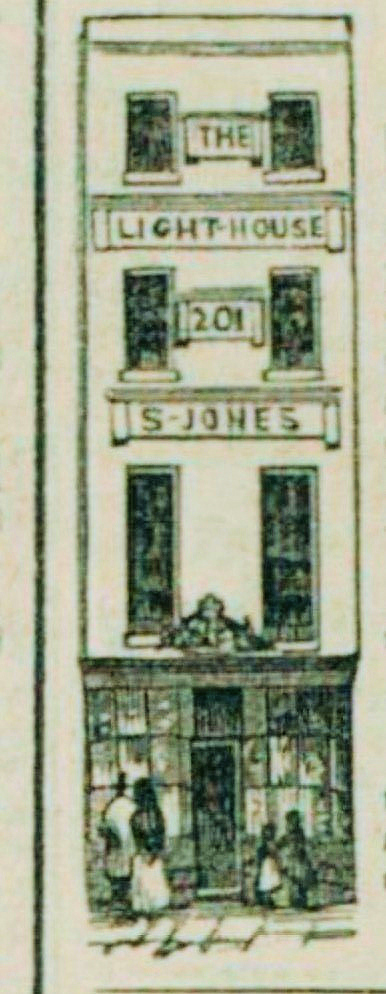
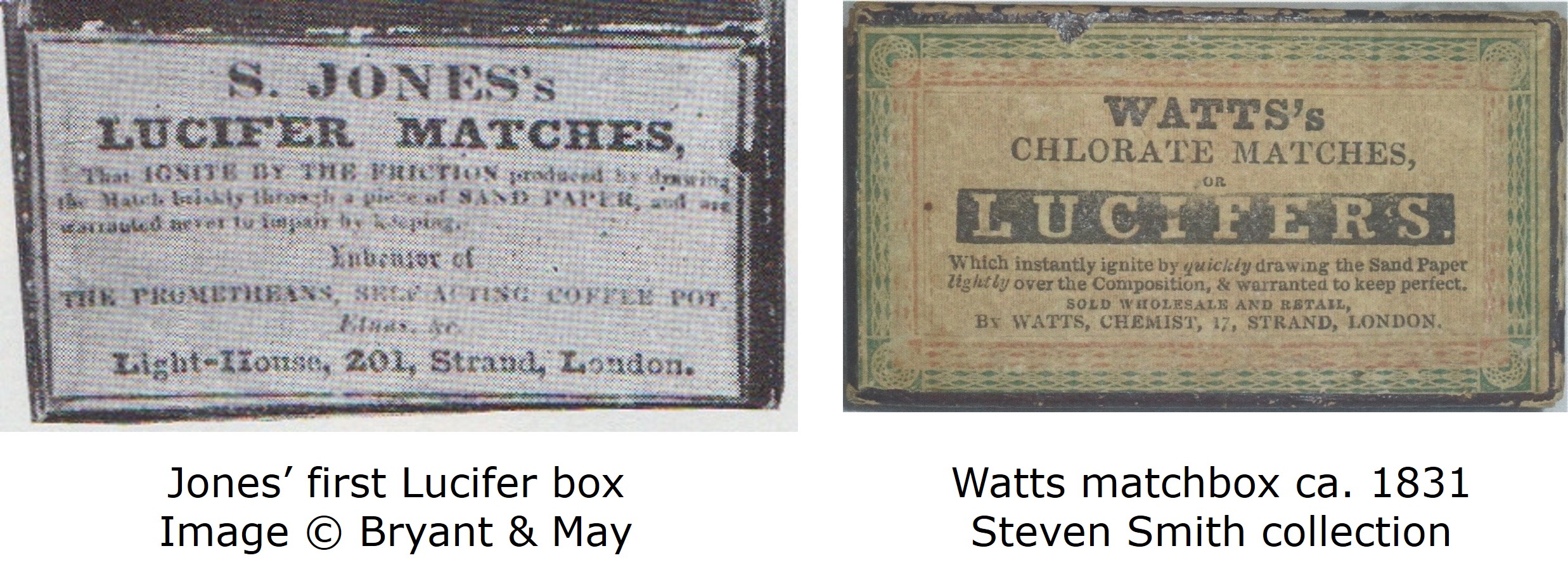
Samuel Jones was the first person to create a commercial business in England making and selling matches. He was a London chemist based at “The Lighthouse” in The Strand. After patenting “Promethean Matches” in 1828 he began advertising “Chlorate Lucifer Matches” in 1830 which were a direct chemical copy of Walker’s Friction Lights.
However, Jones wasn’t the only entrepreneur to notice this new invention.
Another London chemist, George Frederick Watts, also began making Lucifer matches of his own.

A ‘Lucifer’ sales war took place in 1831 between Jones and Watts who both cheekily advertised that they had invented the ‘Lucifer Match’, resulting in first match libel case in the world in November 1831 brought by Jones against Watts.
Jones was only partially vindicated as he won some financial compensation for loss of sales, but the word was now out about this new, exciting invention, and it was only a matter of time before other people got in on the act.
Birth of a new industry
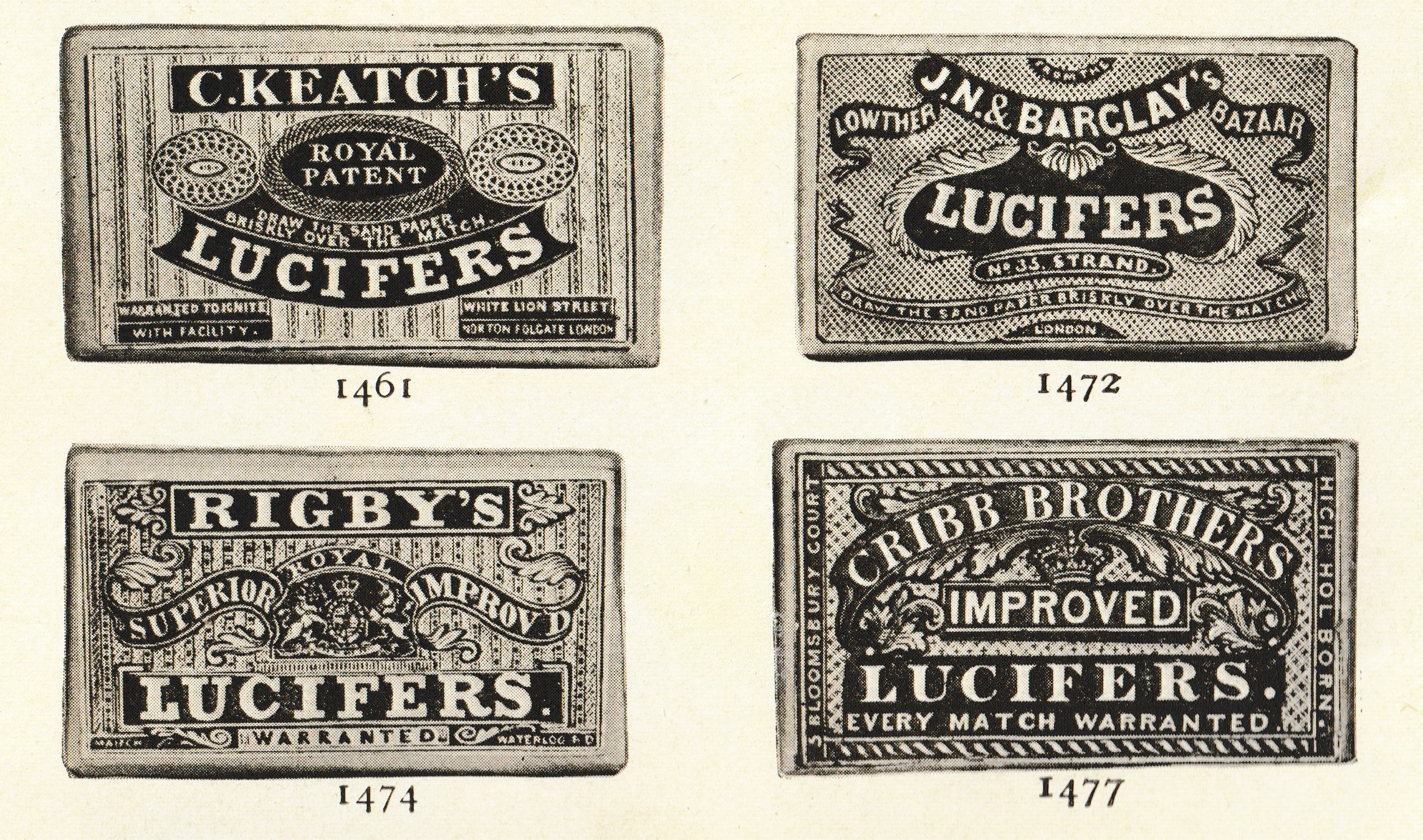
Scores of small, independent match factories sprung up around the country between 1830 and 1865, names like R Bell, C Keatch, Rigby, Hynam, Cribb and many others could be found on the labels of the matchboxes using match names such as Lucifers, Congreves, Vesuvians, Fusees and Vestas. Most were small teams of people performing just part of the manufacturing process, such as cutting the splints, dipping them, packing the boxes etc.
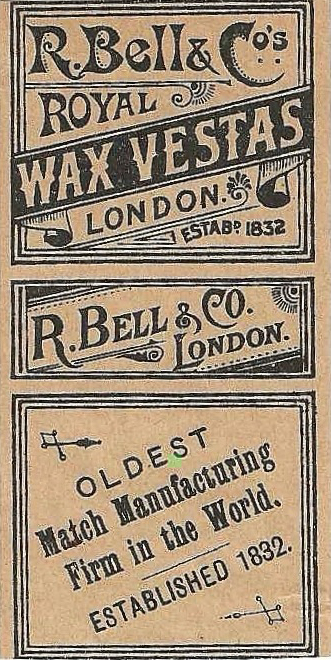
The name “Vesta” for a type of matches first appeared in 1832 when William Newton, a patent agent, patented the “Wax Vesta”.
Newton named his matches after Vesta, the Roman goddess of fire and the hearth.
Wax Matches had been invented by Madame Merckel, a French Chemist and match maker in Paris. Wax Vestas consisted of a wax stem with embedded cotton threads and a tip of phosphorus.
R Bell and Company established the first end-to-end match factory in the world in London in 1832, and bought the Wax Vestas patent from Newton.
However, there was very little standardisation between these manufacturers – the matches were of different sizes and consequently the boxes varied in size too. Matches were relatively expensive too, still out of reach of the poorest in society.

By the time Victoria ascended to the throne in 1837 matches had become a very desirable accessory for the upper classes, who were the only ones who could afford these new items (in an 1833 by-election one of the justifiable expenses was a box of Lucifers, and we know that Walker was selling boxes of 100 Friction Matches for one shilling, a considerable sum).
When the Penny Post started in 1840 word would have been able to spread far and wide about these wonderful new things called matches.
The Great Exhibition of 1851
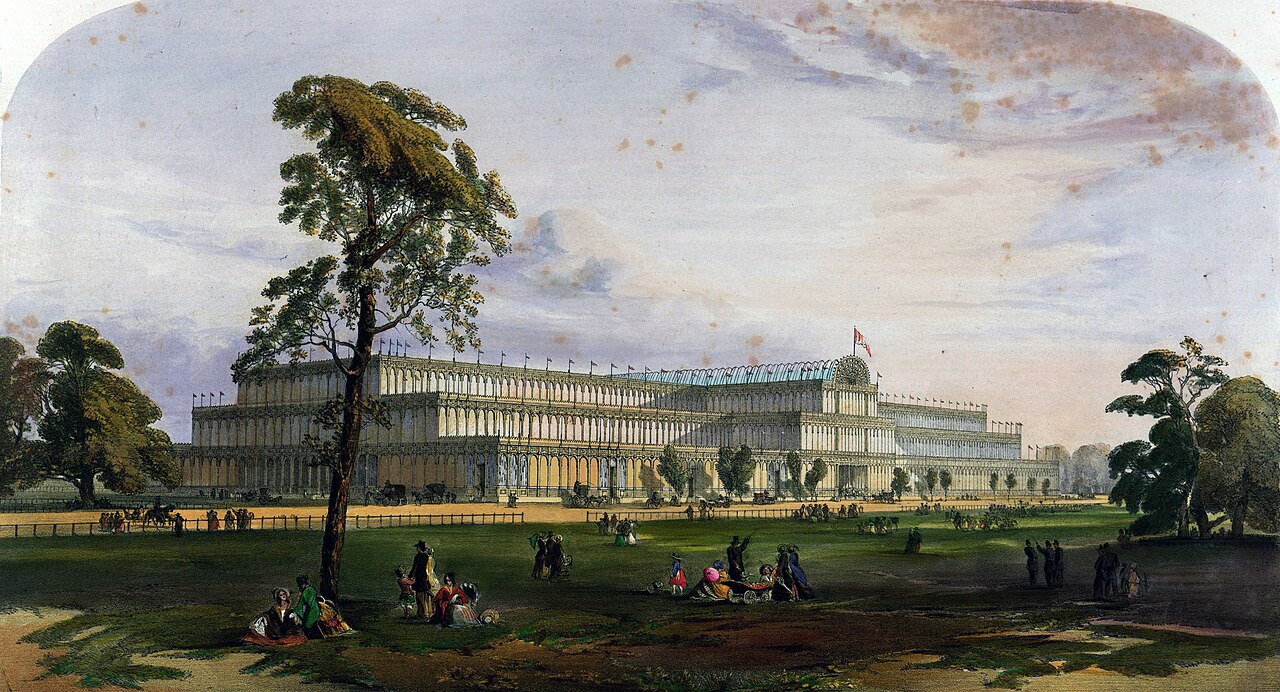
London was host to the first in a series of world’s fairs, exhibitions of culture and industry that became popular in the 19th century. The Great Exhibition of the Works of Industry of All Nations took place in Hyde Park, London, from 1 May to 15 October 1851, and by then sales of matches had become significant enough to merit manufacturers like Dixon Son and Evans of Manchester exhibiting their wares for the public to see.
Among the exhibitors were :
- Bell and Black, Bow Lane. Imitation Vestas, Congreves and Wax Matches; Camphorated round wood congreves
-
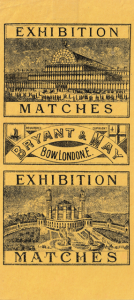
Bryant & May Exhibition matches De Majo. S. Triesch (Austria). Imitation Lucifer matches in great variety
- Dixon Son & Co. Manchester. Matches made with Professor A Schrotter’s phosphorus
- B Schuttenhofen & Goldenkron (Austria). A large display of lucifer matches in a variety of boxes
- P Suhl (Prussia). Imitation lucifer matches
- Hoffman C & G Wisocan Nr Prague (Austria). Imitation lucifer matches
- J Ulm (Wurtenburg). A variety of imitation lucifer matches
- Paris (France). Sliding boxes for lucifer matches, taper stands & amadou in great variety
- M (Mecklenburg-Schwerin). Splints for lucifer matches
- A M Vienna (Austria). Imitation lucifers of several kinds
- F & Co. Vienna (Austria). Various descriptions of imitation lucifers
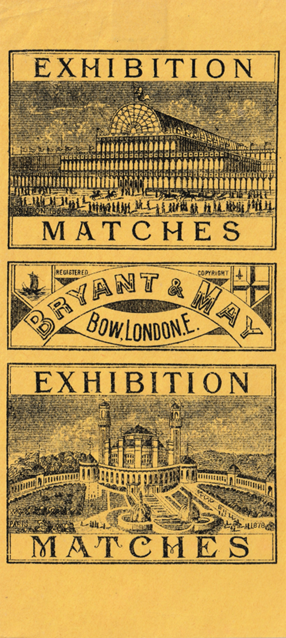
We know that the Lundström brothers from Sweden were there, as were representatives from Bryant & May.
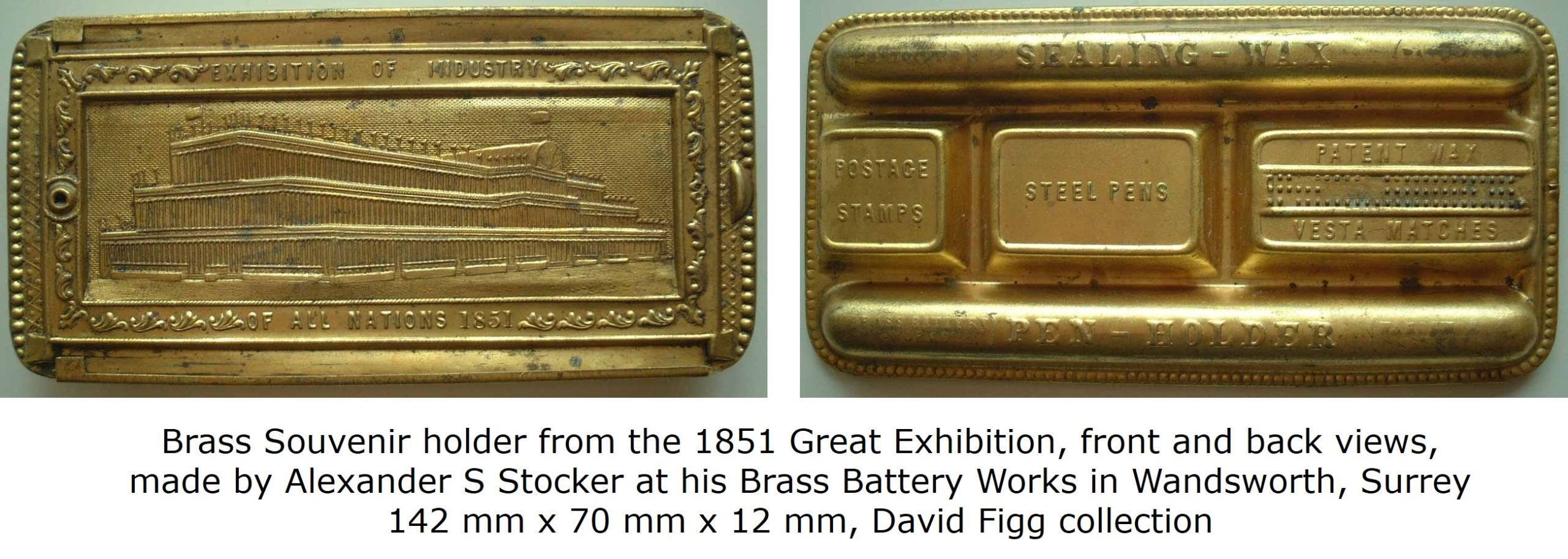
One consequence of all this industrialisation was the increasing affordability of matches for the general public, and particularly from 1860 onwards people were able to buy matches virtually everywhere for a much more reasonable price.
Click here to return to the Exhibition Catalogue.