The Faraday Myth
Exhibitor : Alan Middleton
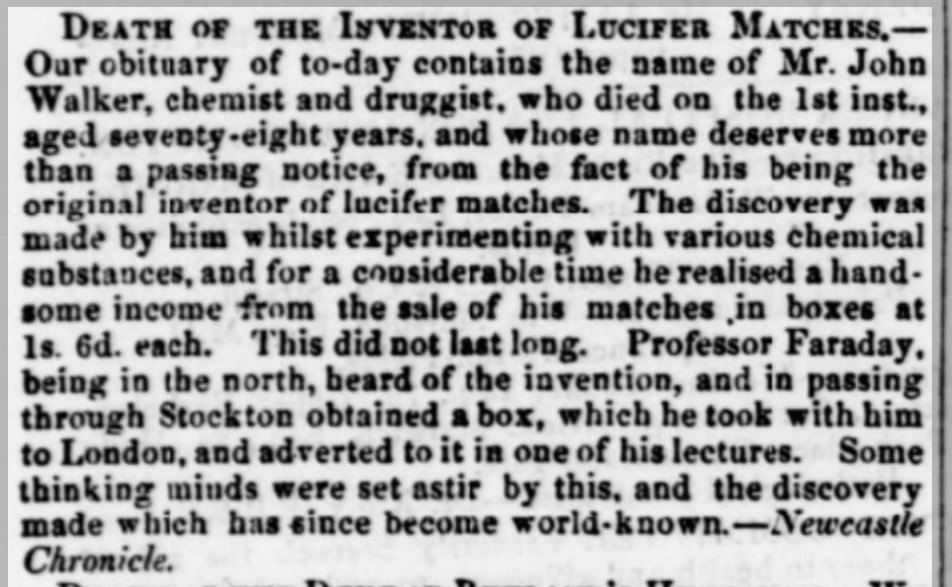
When John Walker died on the 1st May 1859 many national British newspapers carried ‘glowing’ obituaries usually mentioning an association between Walker and Michael Faraday, who was the pre-eminent scientist of the day.
However, there is no evidence to show that Faraday ever met or corresponded with John Walker.
Let’s look into how this myth arose.
Press Coverage for John Walker’s 1826 invention
We know that John Walker’s first sale of his new matches was on 7th April 1827 and was recorded in his Day Book as sale #30. Scholars therefore surmise that his discovery must have happened some time before April 1827, and place the invention date as 1826.
But it wasn’t until September 1829 that the newspapers wrote about Walker’s discovery.
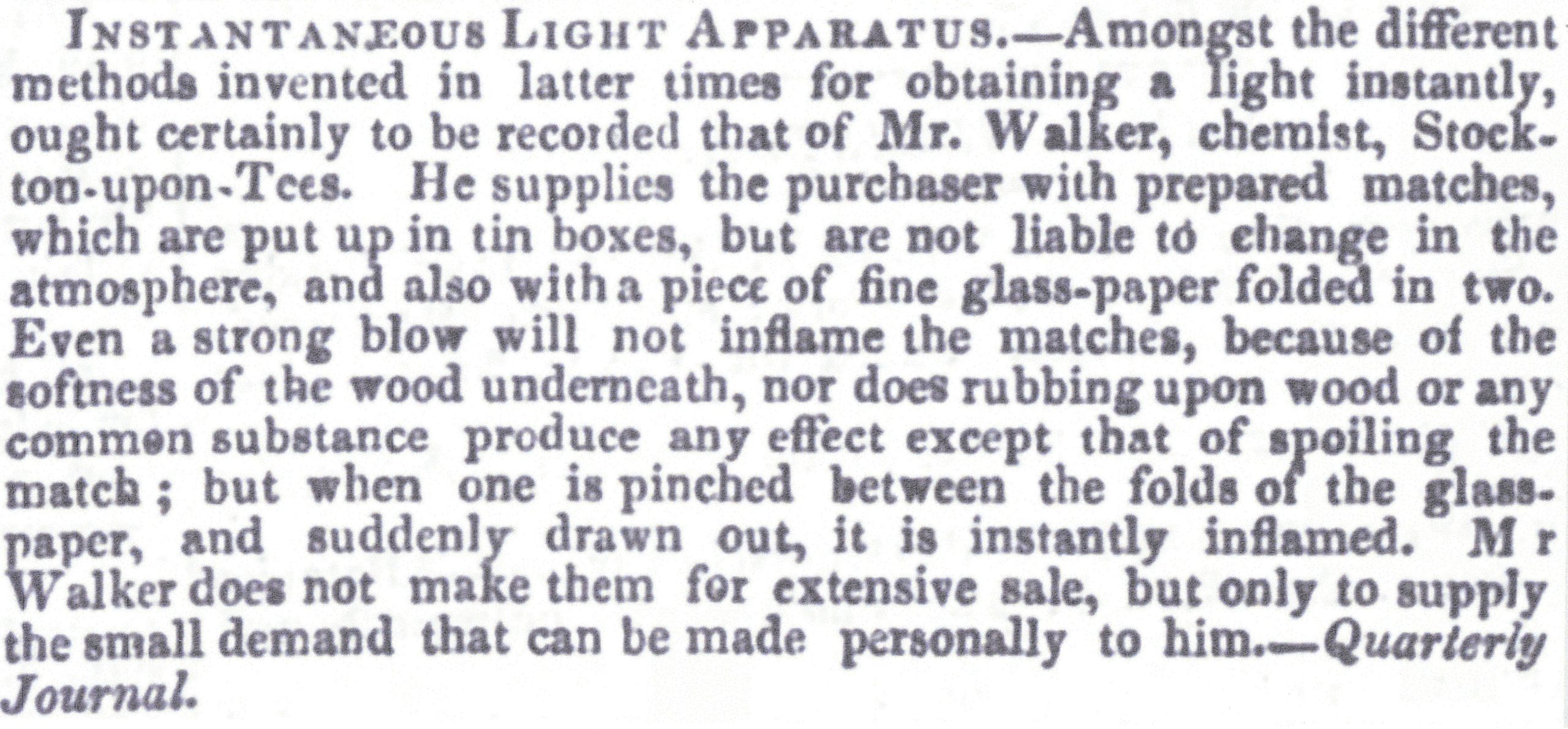
The first ever public mention was on 30th September 1829 in The Globe newspaper, quoting from the soon to be published October edition of the prestigious Quarterly Journal of Science, Literature and Art under the title “Instantaneous Light Apparatus”. The entry read :
- “Amongst the different methods invented in latter times for obtaining a light instantly, ought certainly to be recorded that of Mr. Walker, Stockton-upon-Tees. He supplies the purchaser with prepared matches, which are put up in tin boxes, but are not liable to change in the atmosphere, and also with a piece of fine glass-paper folded in two. Even a strong blow will not inflame the matches, because of the softness of the wood underneath, nor does rubbing upon wood or any common substance produce any effect except that of spoiling the match, but when one is pinched between the folds of the glass-paper, and suddenly drawn out, it is instantly inflamed. Mr. Walker does not make them for extensive sale but only to supply the small demand that can be made personally to him”.
This scientific journal was to a large extent a vehicle for authors associated with the Royal Institution, who took it over in 1830 and it then appeared as the ‘Journal of the Royal Institution’. Unfortunately there is no contemporary evidence of who wrote the article, but the Journal was widely respected and read and undoubtedly spread the word about John Walker’s invention.
Creating the Myth
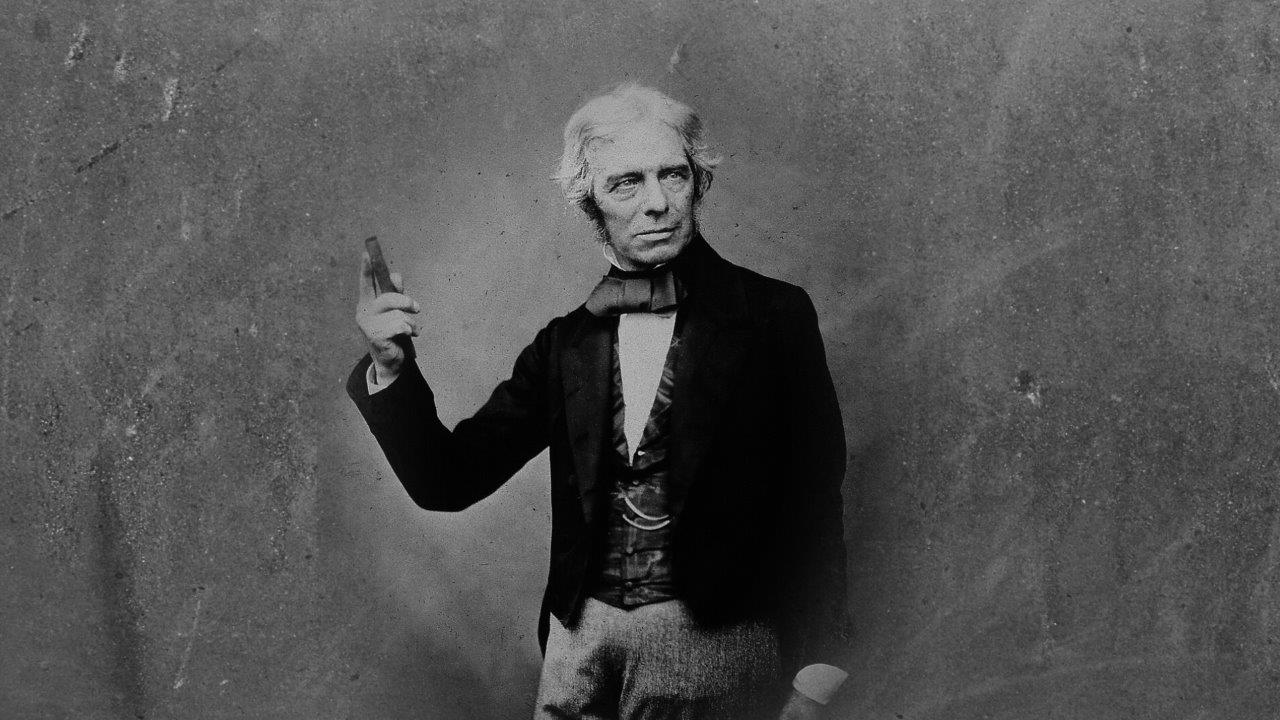
When I started my John Walker research in 2022, many history books and on the Internet claimed Michael Faraday the eminent superstar chemist and physicist of his time (1791-1867) publicly endorsed Walker’s invention and displayed and spoke about it in a London Royal Institution lecture in 1829/30 (the date was never more precise). Faraday was quoted in Walker’s obituary newspaper notices in 1859 that he had visited his shop in Stockton, bought a box of friction lights which he took with him to London and advertised them in one of his lectures and told him to patent them. This is all myth and bunkum!!
Getting to the truth took me over three years of detective work involving correspondence with world experts, particularly Prof. Frank James of University College London. He had been given unique access to 4,900 Royal Institution Faraday letters and papers, and has written six volumes on Faraday. He was able to tell me Faraday fact from fiction based on contemporary evidence at the time.
Professor Frank James told me Michael Faraday was NOT the ‘Traveller’ recorded in John Walker’s Day Book on February 3rd 1829 purchasing three boxes of Friction Lights as surmised by his biographer Doreen Thomas, as he had contemporary evidence he was in London at the time! Also Faraday NEVER gave a lecture on Friction Lights or exhibited them at the Royal Institution as myth would have it in 1829/30, or at any time afterwards. Frank James also checked for me if the Friction Lights were ever on display outside/inside the lecture theatre and they were not!! James also said Faraday had NEVER visited Walker in his Stockton shop, NEVER met or spoken to him, never corresponded with him and did not suggest to him to patent the Friction Lights to PROFIT from them.
Frank James informed me that in 1829/30 Michael Faraday was one of the EDITORS of the Quarterly Journal of Science, Literature and Art (which late in 1830 became the Journal of the Royal Institution). He said the ‘Instantaneous Light Apparatus’ article on John Walker’s matches (Friction Lights as Walker called them) in the October 1829 edition of the Quarterly Journal (edited by W T Brande) COULD have been anonymously written by Michael Faraday but there is no evidence who the author was!
The next question I asked myself was where did the October 1829 Quarterly Journal of Science get the story of John Walker’s invention? One of the speakers at my monthly Normanby History Group lectures mentioned Peter Appleton from Skelton who had written books on the forgotten alum industry of North East Yorkshire. In the UK up to the 19th Century, alum was the primary source of the mineral salt ‘potassium aluminium sulphate’ which had multiple food, household, medicinal, water purification and commercial uses as a mordant to fix dyes onto textiles.
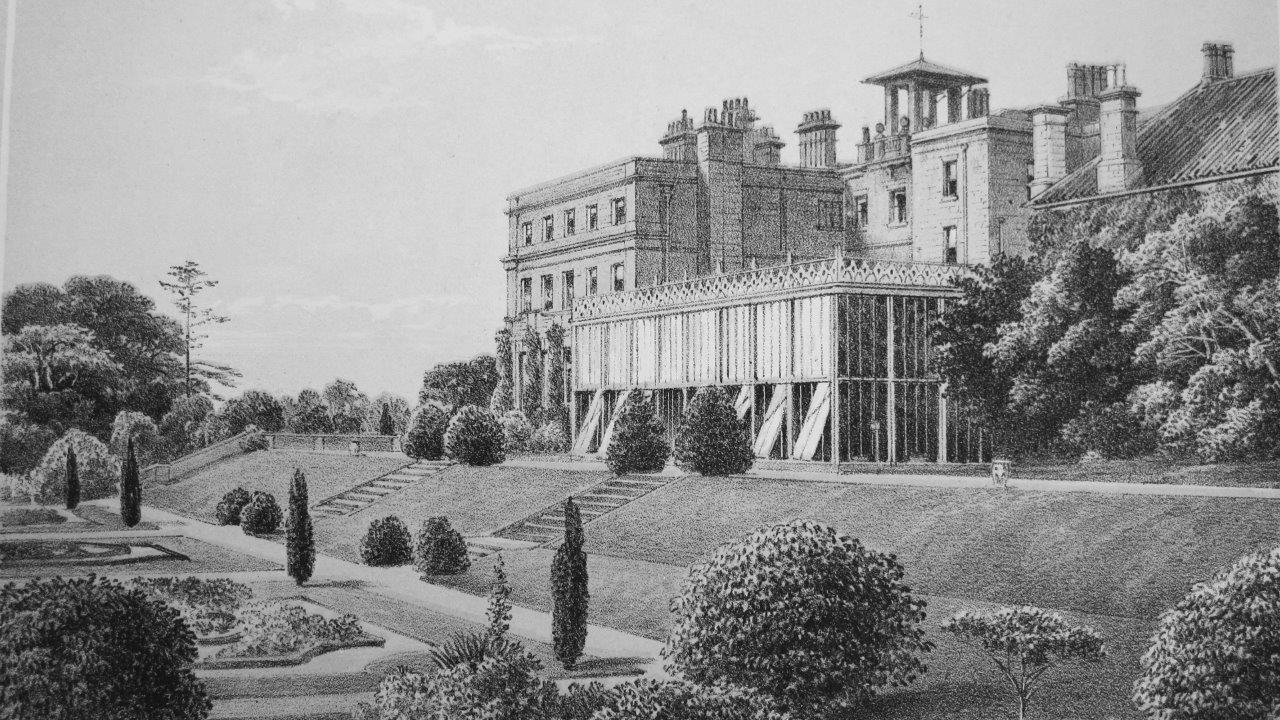
Amazingly and unknown to many historians, Michael Faraday had stayed with the Honourable Sir Robert Dundas MP (Richmond, North Yorkshire) at his Upleatham Hall home in August 1829 carrying out consultancy work on his Loftus Alum Works to increase alum recovery. Michael Faraday was THE respected chemist of his generation and Dundas attended his London Royal Institution lectures in his spare time whilst in Parliament, and persuaded him to do some private work for him in Loftus.
Sir Robert Dundas and his Land Agent Major Alexander Tod were Officers together in the Royal Staff Corps in the Duke of Wellington’s 1808-1814 Iberian Peninsula Army Campaign fighting Napoleon. Critically local Skelton historian Peter Appleton who has extensively researched the North East alum industry told me they were both in the Army Engineering Corps and were military trained EXPLOSIVE EXPERTS. After Napoleon was defeated, they returned to England and Dundas employed Tod as his Land Agent to manage his large estate and Loftus Alum Works in East Cleveland north of the port of Whitby on the North East Coast of England.
BOTH Dundas and Tod purchased Friction Lights from John Walker’s Stockton chemist shop (where their transactions were recorded in the Day Book) in 1828 and 1829, notably in August 1829 when Faraday was staying in Upleatham Hall with Sir Robert Dundas. Walker’s Friction Lights were an obvious interest to Dundas as a source of an instantaneous flame to light the fuses of the explosives for his opencast alum mining and probably his cigars (if he smoked).
I surmise Dundas and Tod in Upleatham Hall showed Faraday this new ‘novelty’ match which gave an instantaneous light obtainable at one’s fingertips they had bought on frequent occasions from a Stockton-upon-Tees High Street chemist John Walker (he called them friction lights). Some of Walker’s customers indeed bought them as mere ‘novelties’, but Faraday with his enquiring chemist mind would have been very impressed by their simplicity of lighting by friction pulling them through glasspaper! He would have wondered what the chemicals were in the tips of the match to achieve this minor miracle and also would have immediately realised their great potential to mankind to overcome the drudgery of the ‘tinder box’. (John Walker kept secret the chemical composition of the match head and no doubt Faraday would have speculated what it was)?
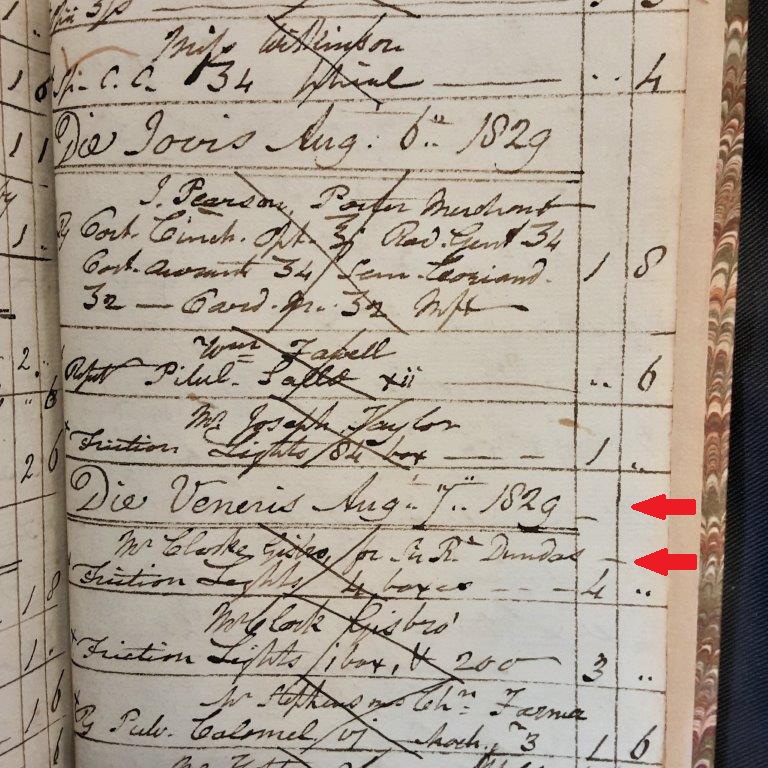
Faraday’s enthusiasm for John Walker’s invention was such that Dundas or Tod bought him some boxes from Walker’s shop in Stockton to take back with him to London. It could have been the FOUR boxes of Friction Lights bought by Mr Clarke of Guisborough for Sir Robert Dundas on the August 7th 1829!!
We know Faraday had left Loftus by September 3rd 1829 as a letter sent by Dundas to his nephew Lord Milton said ‘Faraday had gone’. As Faraday was working 220 miles from London in August 1829, he could not edit the October 1829 Quarterly Journal of Science and gave his ‘Instantaneous Light Apparatus’ article to his fellow Journal editor Brande to publish it for him on his return to London in September 1829. Faraday didn’t give his name to the article and there is no firm evidence it was from Faraday but for me there is excellent circumstantial evidence to say it came from Faraday because it was published only a few weeks after Faraday’s return to London from Loftus.
What is remarkable in my research is that when I discussed in June 2025 with Prof. Frank James that Faraday had been working in the North East in Aug 1829, he of course was aware of Faraday’s working visit but crucially was UNAWARE that Dundas and Tod had purchased Friction Lights from Walker during his North East visit. Frank James was aware of John Walker’s Friction Lights Invention and his chemist shop Day Book recording all his sales and customers, and that Faraday had being associated with publicising John Walker’s invention. He was aware of Doreen Thomas’s 1971 John Walker ‘Strike a Light’ book and her Faraday ‘Traveller’ theory. However crucially, Frank had not seen Doreen Thomas’s 1981 book listing the Friction Light purchasers in the Day Book and therefore he hadn’t made the Faraday connection to Dundas and Tod. Similarly Peter Appleton the world renowned North East Alum mines researcher had extensively researched the visit of Michael Faraday to Sir Robert Dundas and Major Alexander Loftus Alum Works in August 1829 but was unaware they had bought friction lights from John Walker at the time of his visit!!
I told Frank James my theory and the circumstances of how possibly Michael Faraday was the source and the author of the anonymous article on John Walker’s Invention written on his return to London in September 1829 after his working visit to Loftus Alum Works in August 1829. Frank didn’t know why Faraday hadn’t put his name to the article published in the October 1829 Quarterly Journal of Science other than I surmised he may have dictated it to his clerk for Editor Brande to include it in the Journal. The article said “Mr. Walker, chemist of Stockton-upon-Tees had invented a match which obtained a light instantly, made personally by him but there only was a small demand and he did not make them for extensive sale”.
It was very satisfying and to come from such an eminent and world expert historian on Michael Faraday, that in May 2025 Prof. Frank James AGREED WITH MY THEORY on the possible circumstances how the world first heard about John Walker’s invention, most likely via Michael Faraday’s anonymous article in the October 1829 Quarterly Journal, and as they say the rest is history!
It is very rewarding that in this day and age an amateur historian like myself can still discover NEW information on John Walker’s Invention 200 years ago and also debunk some long held Michael Faraday ‘facts’ as actually myths! Rewriting the history books and publicising my research in the British Matchbox Label & Bookmatch Society ‘Match Label News’ magazine in December 2025 makes me a very proud member of the Society. Thank you BML&BS for my enjoyable 57 years of membership!
Click here to return to the Exhibition Catalogue.