
Croatian match industry

Exhibitor : Zdenko Ukmar
The history of the Croatian Match Industry is dominated by the Drava factory which was established in Osijek in 1856 by Adam Reisner, an Hungarian Match Manufacturer. Osijek is situated on the southern bank of the Drava river, which is a tributary of the Danube river.
During the late 19th Century Osijek was in the Austro-Hungarian empire. Croatia declared independence in 1918, but became art of Yugoslavia from the time if the second world war until becoming an independent country in 1991.
This is why labels from the Drava factory can show many different countries of manufacture.
Drava factory (1856 – 2004)

The DRAVA match factory was founded in 1856 in Osijek. Initially Drava operated as a firecracker workshop. Production was initially manual. In 1872, it employed 35 workers and processed about 500 m2 of wood. In 1890, the production of the first matches (sulfur matches) began.
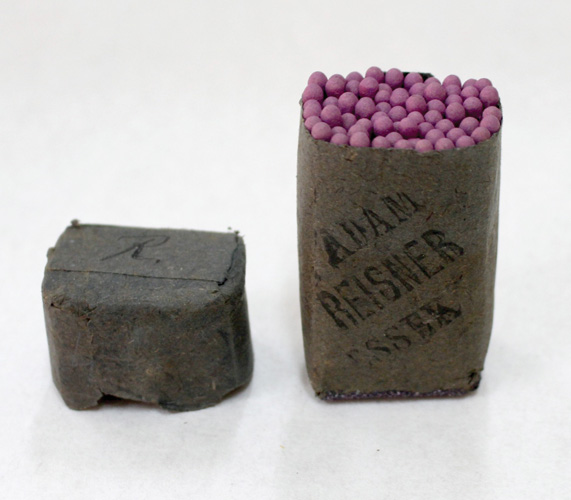
In 1886, new machines were purchased for planing matches and making cardboard boxes.
At the turn of the 19th century, new machines for veneer boxes were purchased, and they were filled mechanically.
In 1902, it employed about 340 people and produced Swedish safety matches. At that time, production amounted to 12,000 crates (5,000 boxes each) per year.
The matches were sold throughout the Austro-Hungarian Empire, and were exported to Turkey, Egypt and the Middle East. At that time, it was called ADAM REISNER ESSEGG.
In 1909 it was converted into a joint stock company. Since then it has been called TVORNICA ŽIGICA DRAVA. The Reisner family has remained the majority owner.
The first automatic machine was purchased from Sweden (1930), and everything was produced by machine. A label-splitting machine and a new log sawing machine were installed. At that time, 180 workers were employed, and the annual capacity was increased to 26,000 crates.
After WWII, the company was nationalized. In 1945, 16,733 crates were produced, and in 1949, 71,639. Demand was greater than production. The first export was in 1951, to 60 countries around the world.
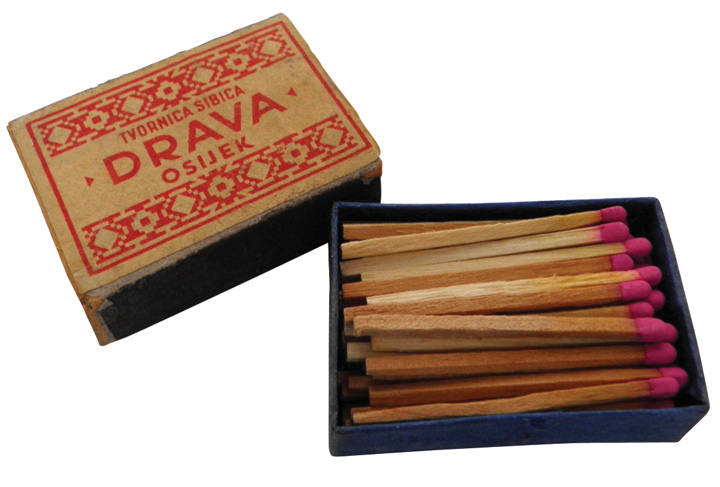
In addition to matches, they also made fruit crates, ice cream sticks, and miners’ matches. The basic raw material was Canadian poplar from their own plantation in the early 1950s.
In 1970, with modernization, the assortment was expanded. At the end of 1960, 80% of the machines were replaced, and 180,000 crates were produced per year, a third of which was exported.
Then in 1980, due to decreasing demand (cheap gas stations), a new facility was installed, so baling caps and semi-propylene fibers for the brush industry and construction were produced (100 tons were produced in 1990) of all sizes, and 20% were exported to Italy and Sweden.
With the loss of the market and considerable damage during the Homeland War, the company found itself in problems.
Privatization was carried out in 1993. That year, the new FLAMINGO ecological stamp was designed and put on sale, which was a rarity on the domestic and world market, 40,000 boxes were produced annually.
The new owner took over the company in 2001, and production was shut down in 2004.
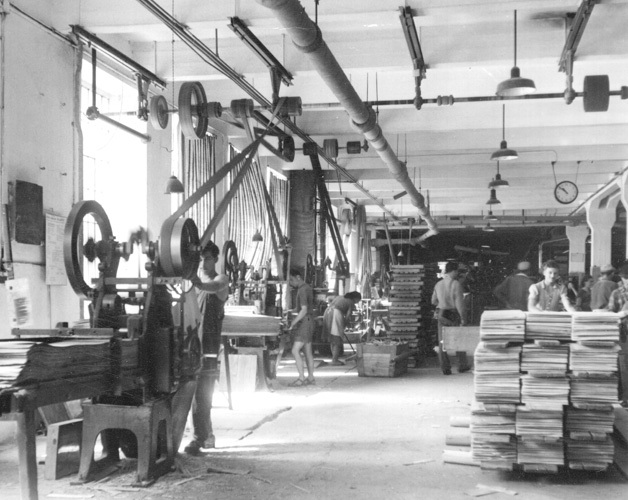 19th century plant
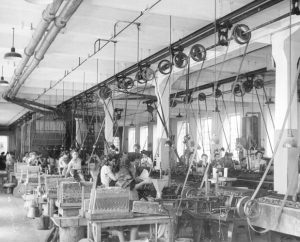 20th century plant
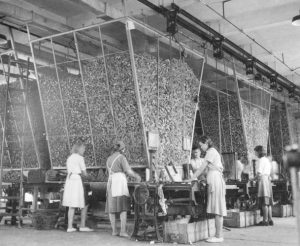 Making boxes in the 20th century
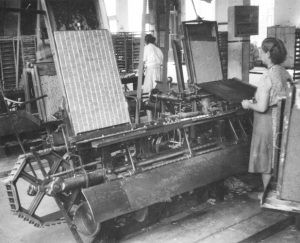 Lubricating the friction surface on the box 20th century

Bonus exhibit : Matchbox labels from Drava
Work in Progress
Click here to return to the Exhibition Catalogue.