Walker the man, Walker the inventor
Period covered : 1781 to 1859
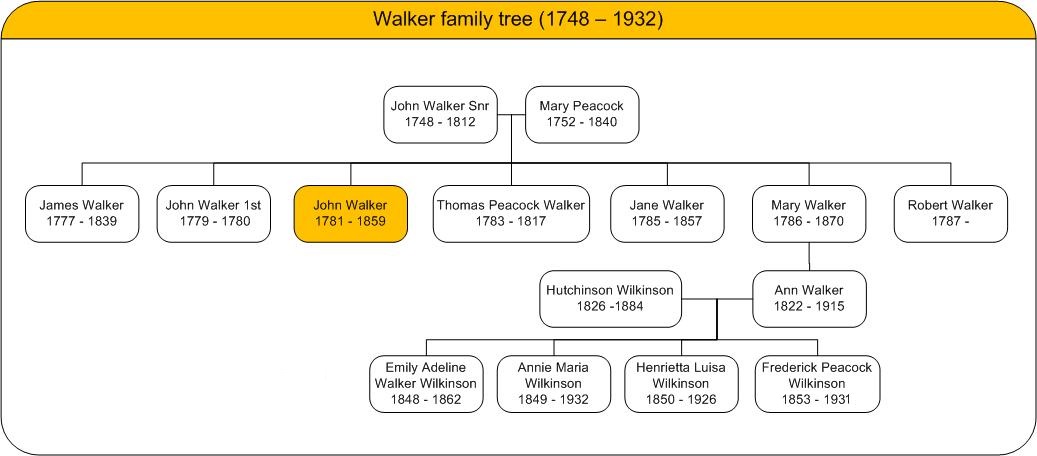
John Walker was born on the 29th May 1781, he was the third of seven children born to John Walker Snr. and Mary Peacock who had a grocery, wine and spirit shop at 104 High Street, Stockton-upon-Tees which is known as having the widest high street in England.
John Jnr. showed academic excellence and is thought to have attended the Stockton Grammar School. At age 15, he was apprenticed to Stockton Surgeon Dr. Watson Alcock, where (according to John’s great-niece Annie Maria Wilkinson) he became a fully qualified Surgeon. However, surgery in those days was a gory business where the patients were in great pain, and after experiencing the horrors of many operations he decided the medical profession was not the career for him.
1819, a new chemist in town
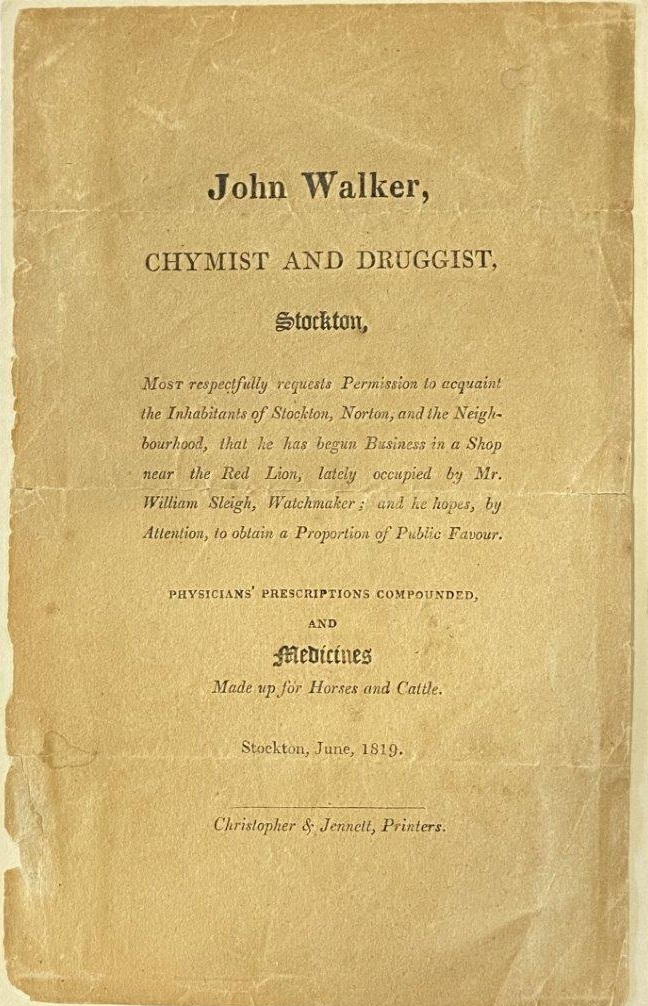
After re-training with pharmacists in nearby York and Durham he opened his own shop in Stockton-upon-Tees in 1819, at No. 59 on the east side of the High Street. The shop was rented from Thomas Jennett, a three times Mayor of Stockton, who lived next door with his family at No. 58 where he ran a successful printing and booksellers’ business.
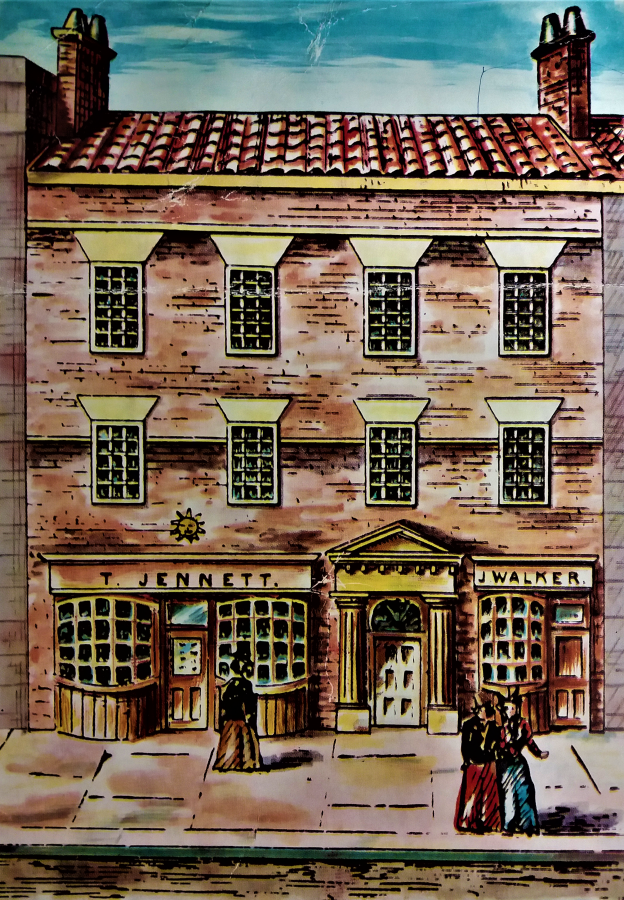
Business was brisk at his “Chymist and Druggist” shop, and it was from here that he dispensed medicines to the citizens of Stockton. John’s customers initially referred to him as Dr. Walker from his previous profession before in time he came to be known as just Mr. Walker.
John liked to experiment with explosive mixtures of chemicals to make percussion caps for guns, and sales of this nature were recorded in his sales ledger (Day Book) in 1825 and 1826.
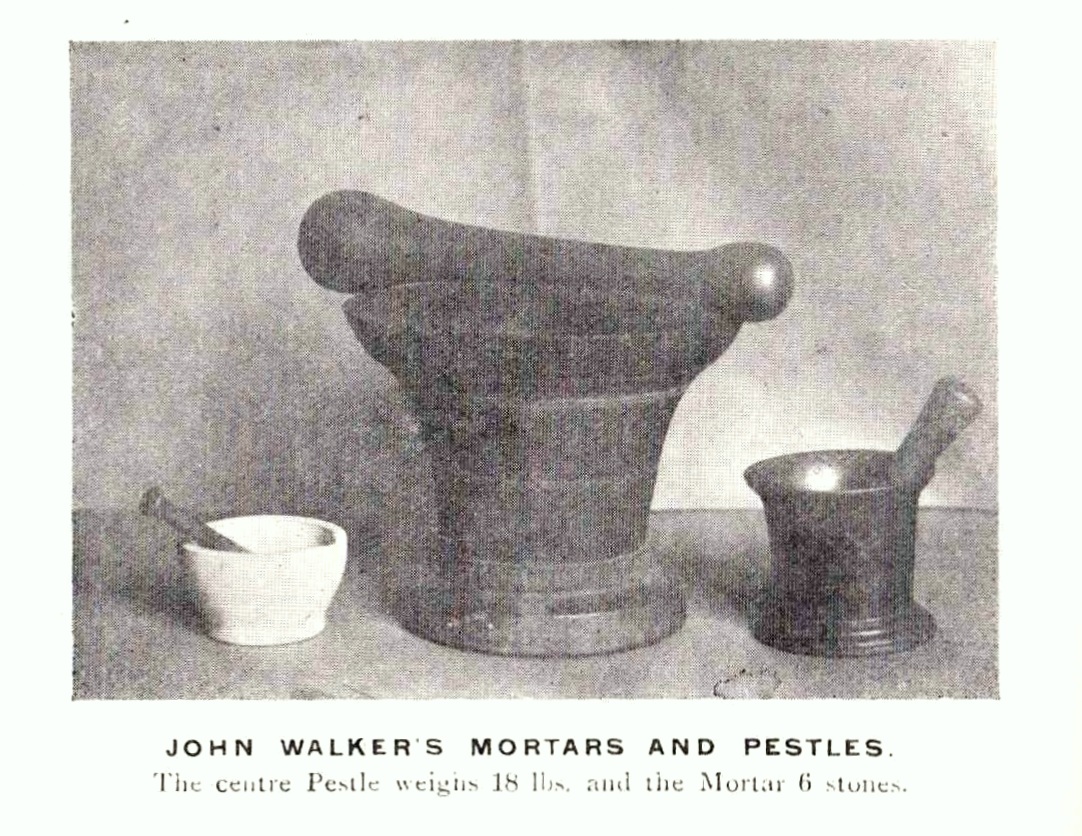
Key tools of the trade for chemists were their Pestles and Mortars, and three of John Walker’s have survived and are now held by the Science Museum. The largest mortar is made of bell metal and weighs 84 pounds (38kg).
1826, the breakthrough
John Walker liked to experiment with explosive mixtures, and one day in 1826 he was mixing a quantity of explosive substance at his home on Quayside and happened to scrape the dried stick he had been using on the hearth and it caught fire.
The scientific brain of this trained chemist quickly realised how he could apply what had occurred and he set about creating a new kind of match, thin wooden splints pre-coated with combustible chemicals.
This was Walker’s genius : he realised that friction, of a chemical mixture on a rough surface, was a reproduceable way of making fire easily and safely.
The splints were ignited by pulling them through glass paper, and the promise of a simple, safe and affordable way for everyone to make fire was born : “freedom from the terrible tyranny of the tinder box” would soon be possible.
Of course, he also recognised a potential new business opportunity, to manufacture these new matches and sell them to the people of Stockton.
Sales of Friction Lights
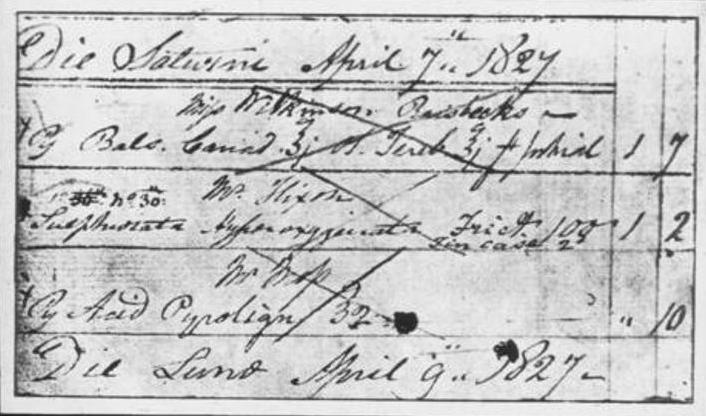
The first recorded sale of these new matches was on 7th April 1827. It was a sale of 100 Sulphurata Hyperoxygenata Friction costing 1 shilling plus 2 pence for a tin case to hold them to a Stockton Solicitor Mr. (John) Hixon, recorded as Sale No. 30 in the Day Book.
When they first went on sale Walker’s Friction Matches were considered to be novelties, but John soon realised their potential and stepped-up production for his customers. Later, he recognised how Friction Matches could make a tremendous difference to people’s everyday lives, giving them instantaneous fire on a splint of wood between their fingers instead of having the laborious and cumbersome task to get a spark from a flint and fire steel to ignite shaves of wood and rags in a Tinder Box.
John started using the name “Friction Lights” for his matches from a sale on 7th September 1827.
The Day Book is John Walker’s sales ledger, which luckily survived and is now owned by the Science Museum. It lists credit sales between 9th August 1825 and 23rd September 1829, during which time there were over 170 entries for sales of matches totalling over 23,000 matches.
Walker’s new matches were sometimes bought by young men in Stockton who allegedly used them to frighten unsuspecting girls by creeping up behind them, lighting a match and throwing it on the ground, and were nicknamed locally “Walker’s Pea Crackers”.
Although Walker kept the chemical composition of his matches a secret, a 1927 analysis by Stocktonian Professor Bone revealed that he used equal parts by weight of potassium chlorate and antimony sulphide, made into a paste with starch and gum which was afterwards used for the tips. The matches were thin splints of wood, three inches long, one sixth inch broad and one twentieth inch thick.
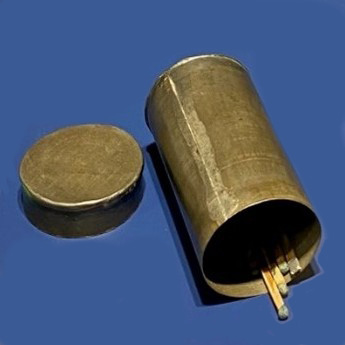
John Walker’s first sale was 100 matches for a shilling which fitted into a cylindrical tin case (which cost an extra two pence). He also sold them loose in bundles of 100 or for example 25 for three pence or 50 for six pence. Looking at the records of sales in the Day Book the figure 84 matches for ten pence first appeared on 7th September 1827 sold to Mr Fenwick together with a tin case costing two pence. On 27th December 1827, the first sale of 84 matches and a box was to Mr & Mrs Bewick for one shilling, and many more Day Book entries show sales of 84 matches and a box. The wholesale price of tin cases became expensive in 1827 which was a problem. To overcome it, Thomas Jennett produced more and more cardboard boxes for John of a certain size which meant he could still sell friction lights for one shilling, which is a nice round figure without the need to buy a tin case. John gave his customers one extra friction light as an incentive to buy a box as the maths says there should have been 83 in each box but he gave them 84. Everyone was a winner as the friction lights were now sold in a small portable cardboard container attractive to his customers which could fit into the pocket or ladies handbag, and for John the selling price of his friction lights remained the same. Also presumably John was making money on the wholesale cost of the easily manufactured cheap cardboard boxes as opposed to the expensive tin cases.
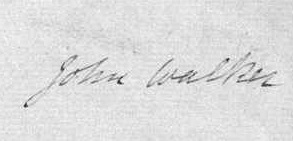
It is probably because he had sufficient means for his own requirements that he stubbornly refused to patent his invention (though he was encouraged to do so) and preferred to spend time on his hobbies of botany, mineralogy and particularly experimenting with chemicals. Of course, obtaining a patent was an arduous and detailed process, and he might also have decided that his invention was too ephemeral to patent.
Images of John Walker
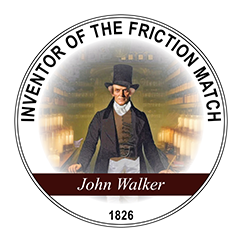
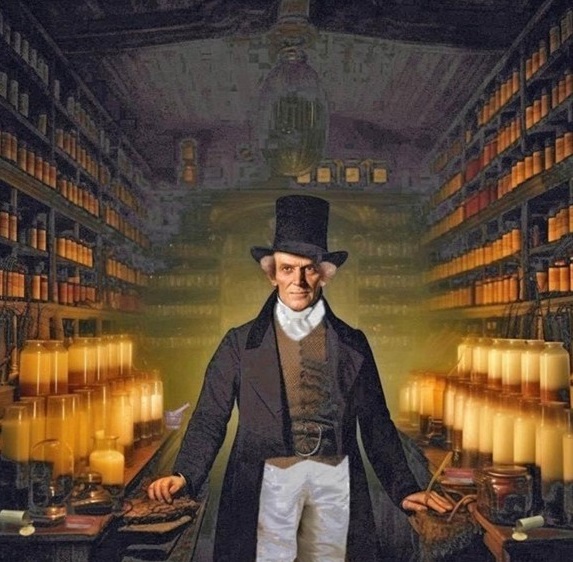
Unfortunately, John gave no public interviews nor any personal account of his life nor is there any verified image of him, so we have to rely on anecdotal evidence from his family, friends and customers to get some clues about the enigmatic John.

Since 1927 a number of attempts have been made to find an image of John Walker, but these have all proved to be false. The Society has used Artificial Intelligence (AI) to create the image of John Walker used on this web site, by taking all the contemporary written accounts and synthesising an image.
Life and death
In his lifetime, John Walker was known as “The Stockton Encyclopaedia”. He was a well-respected member of the local community, a successful businessman and an expert on local history.
When John’s father died in 1812 the lease on the grocery shop would have been given up by his wife Mary. As the Walker family living quarters were above the shop, mother Mary would have soon moved out with her unmarried children probably to the house in Cleveland Row, Quayside which was then a pleasant and desirable accommodation overlooking the racecourse across the River Tees.
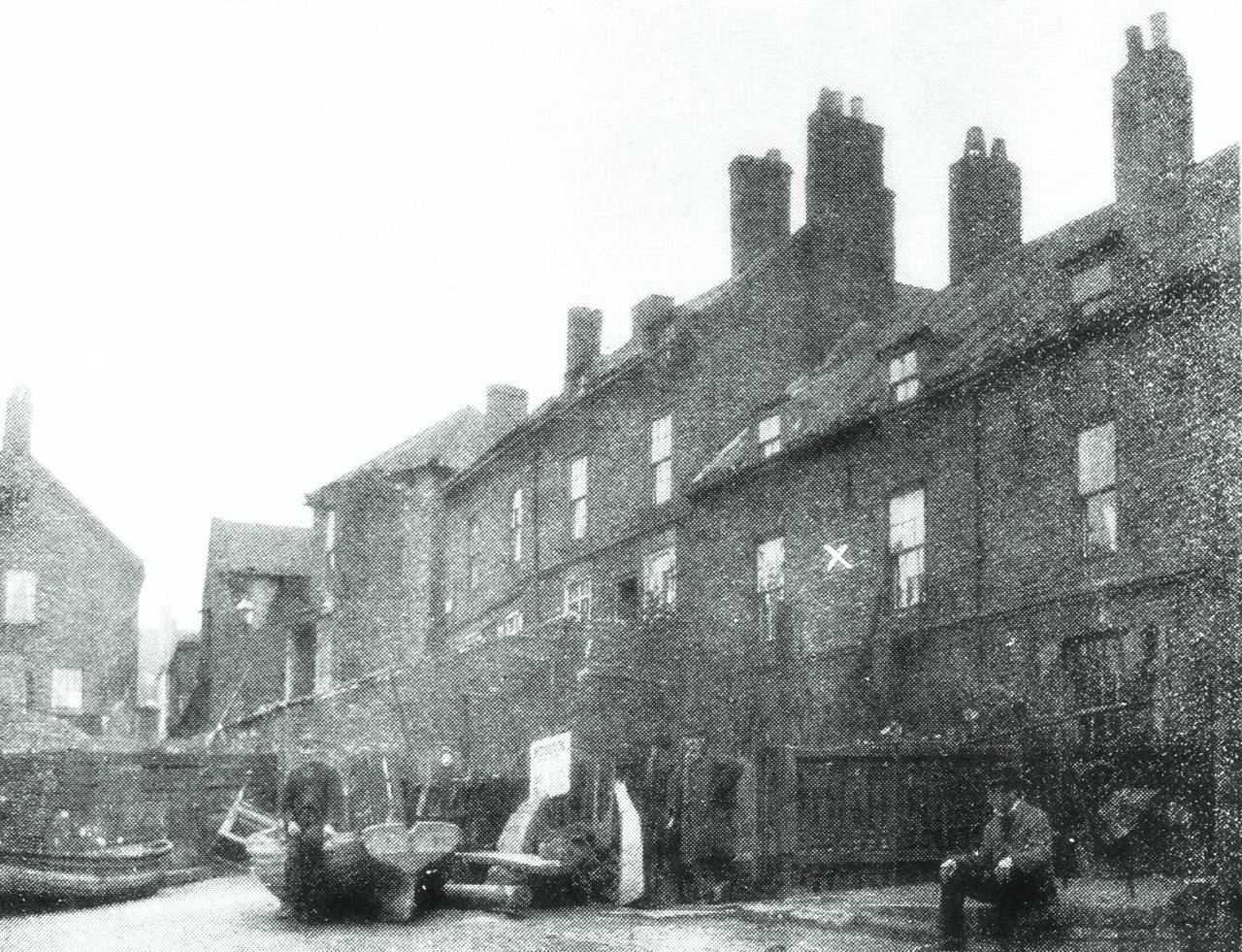
When John returned to Stockton to open his Chymist and Druggist shop in 1819 he is likely to have moved into Quayside to join his mother, his two unmarried siblings Jane, Mary and her daughter Ann. It is in this house that John Walker made his great discovery, according to written testimonies by his niece Ann and her daughter Annie.
After his mother Mary’s death in 1840, John and his siblings moved from their Cleveland Row house on the Quayside to the more upmarket town house 1B The Square possibly around 1841.
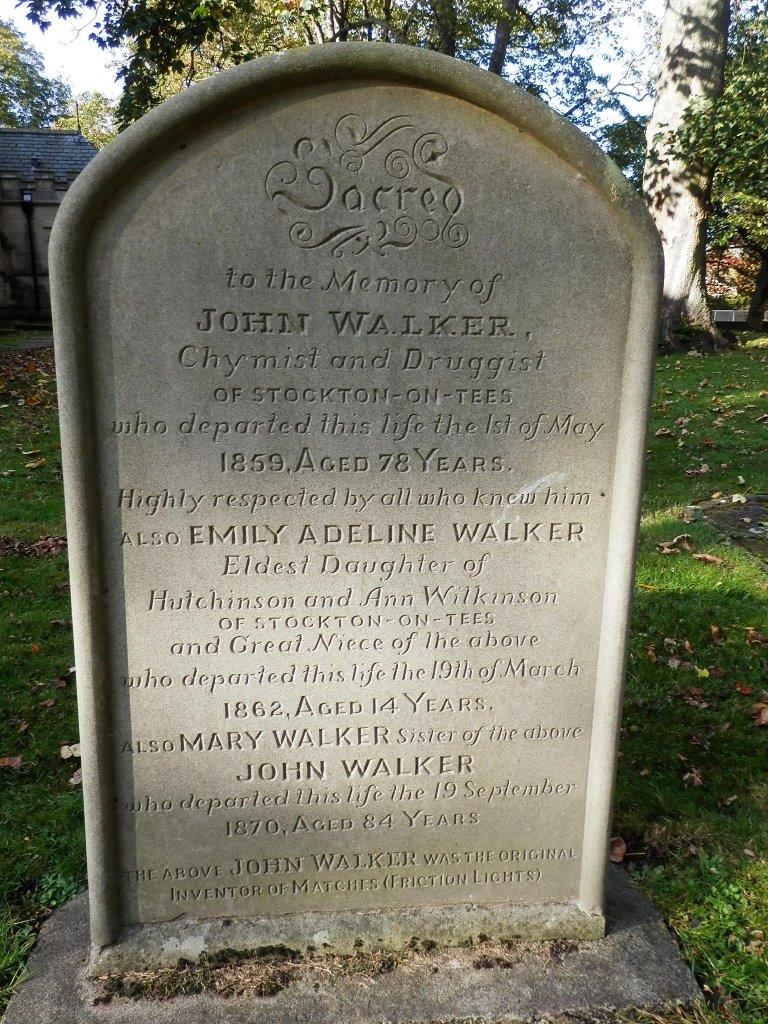
John retired in 1858. He remained a bachelor all his life and lived in Stockton until his death on the 1st May 1859 aged 77. John’s death certificate showed he died in his house in Stockton of ‘heart disease and dropsy’.
He was then known as the inventor of the Lucifer Match and not the Friction Match, as this was the name commonly in use.
Many national British newspapers carried ‘glowing’ obituaries usually mentioning an association between Walker and Michael Faraday, which is attributed to the Journal of 1829 and Michael Faraday’s connections with The Royal Institution. However, there is no evidence to show that Faraday ever met or corresponded with John Walker.
Will and Probate

John Walker wrote his Last Will and Testament on will on 23rd November 1857, where he appointed the Stocktonians John Kirtley (Wine Merchant) and Thomas Appleby (Bookseller) as his executors. Interestingly, he signed the document as Johanas Walker, which was witnessed by John James Wilson (Solicitor, Stockton) and his Clerk John Alderson.
On 7th July 1859, after his death, this Will was exhibited in Her Majesty’s High Court of Justice at Durham District Probate Registry and was used to prove the Probate which concluded on 12th July 1859. There is a common belief that John Walker died penniless, but this is not the case, as can be seen from this detailed analysis of the Will and Probate documents by Alan and Mark Middleton which shows that his Effects were under £3,000 including Leaseholds.
Doreen Thomas, tireless champion of John Walker
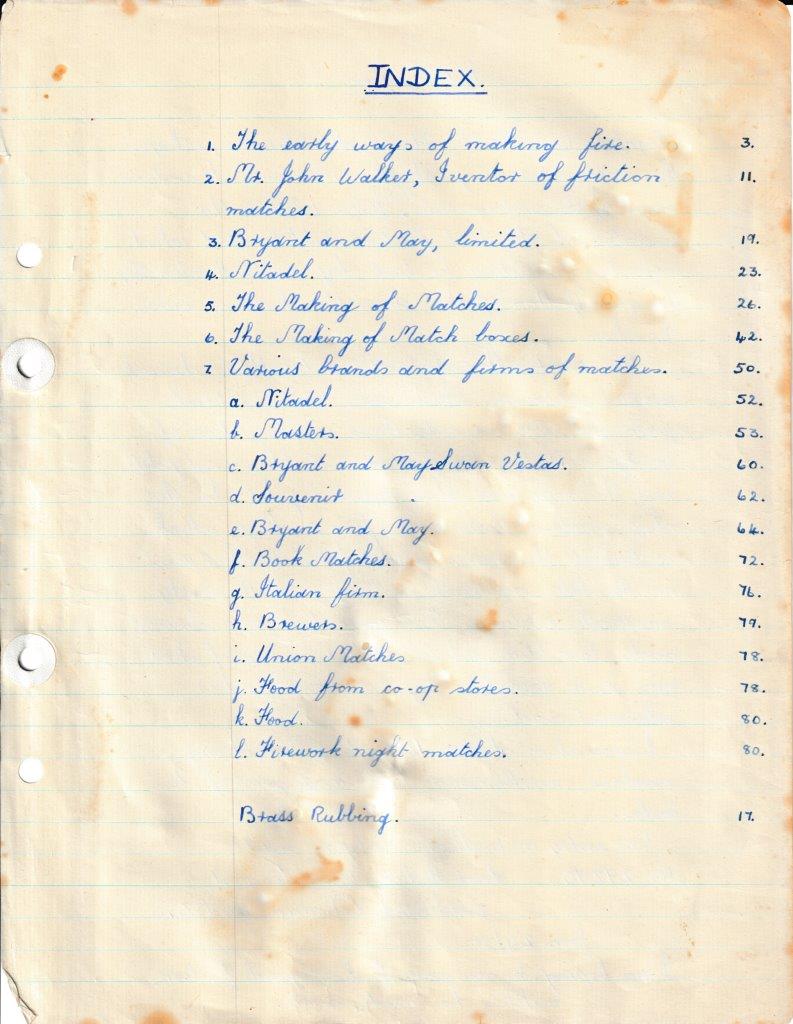
In the mid 20th century John Walker was little known outside of the North East of England, and even then was a largely forgotten figure. But that started to change in 1958 when the 12-year old schoolgirl Greta Thomas in Middlesborough took part in a school project to illustrate a story that was important to the pupil. Greta chose as her subject “John Walker, the inventor of the Friction Match”, wrote to Bryant & May for advice and guidance, and created a 91-page scrapbook containing an extensive handwritten description not only of John Walker and his invention but also a history of fire making together with contemporary photographs of match making plus some actual box tops, bookmatches and chemical compositions.
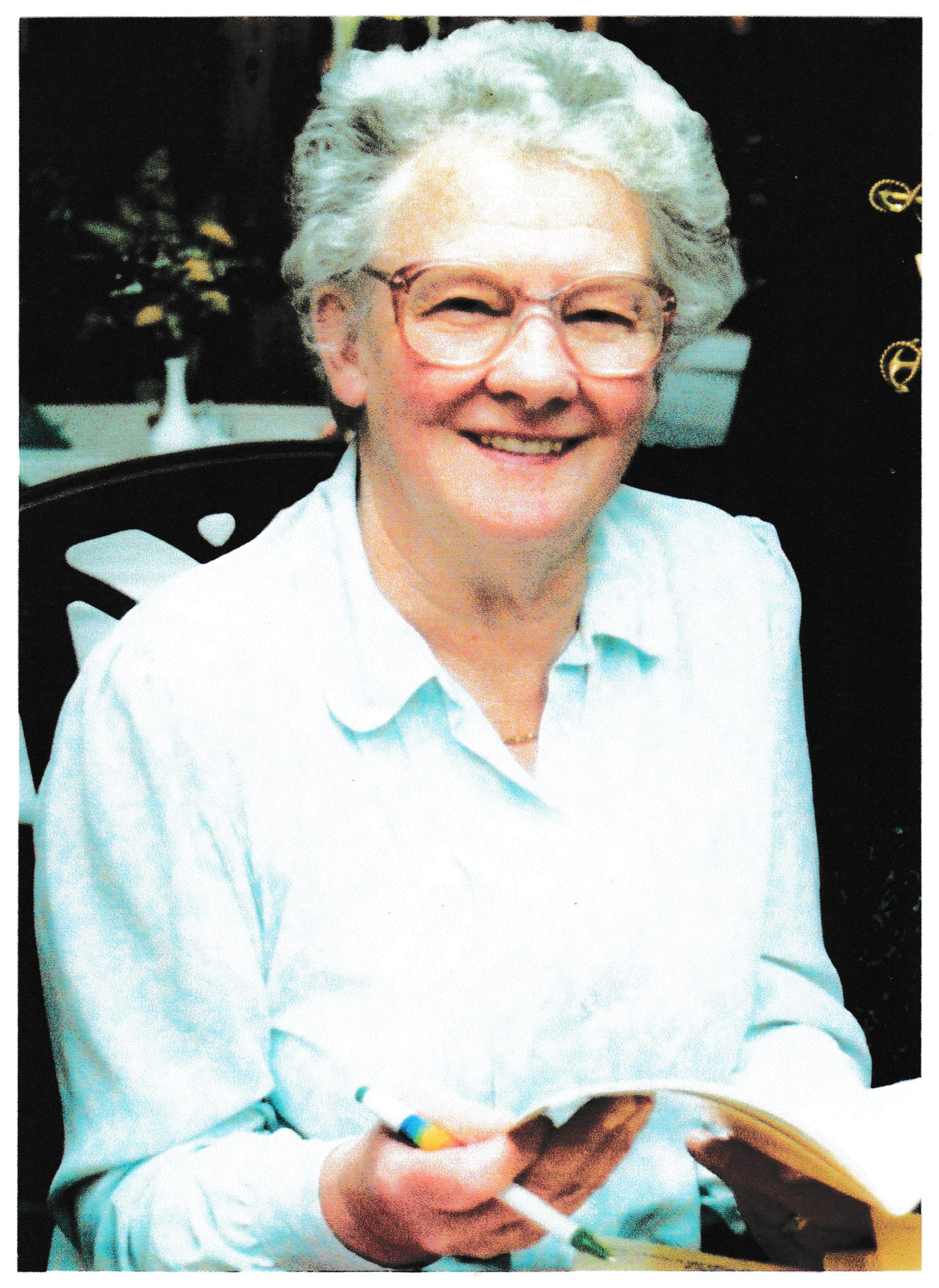
Greta’s mother Doreen was so inspired by her daughter that she started a lifetime’s work to research and champion John Walker through the publication of many books, articles and talks about the great man. Luckily for us Greta’s Schoolbook has survived and is now back in the family’s possession.
Without Greta’s initiative and Doreen’s tireless enthusiasm it is likely that John Walker would have remained an important local businessman who was overlooked outside the North East of England. Because of their work we can now recognise and celebrate his importance to the world.
Click here to return to the Exhibition Catalogue.